Content Removal 7 min read
LegalObserver.com Content Removal: How to Delete Your Profile in 2026
In this guide
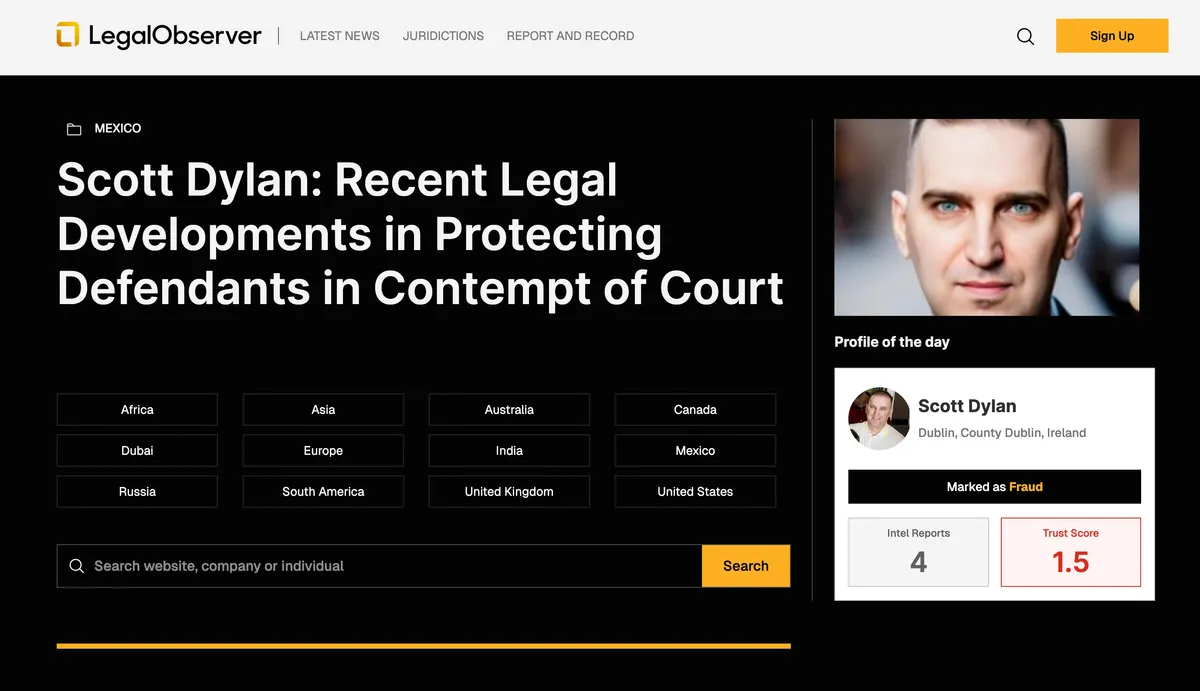
LegalObserver.com presents itself as an accountability platform operating under the tagline “Accountability Through Documentation.” The site profiles individuals and companies from across the globe—labeling them as “Marked as Fraud,” “Marked as Suspicious,” or “Marked as High Risk”—while assigning proprietary Trust Scores that routinely land between 1.4 and 2.4 out of 5. For anyone who finds their name indexed there, the experience is jarring. The platform combines the aesthetic legitimacy of investigative journalism with the opacity of an anonymous operation, and that combination makes removal exceptionally difficult through standard channels.
What LegalObserver.com Actually Does
The site constructs dossiers on named individuals and businesses, drawing from what it describes as “publicly available sources including court records, regulatory filings, corporate registries, and archived media reports.” Research is attributed to “journalists, OSINT analysts, researchers, and citizen contributors who review and cross-reference verifiable information.” No named editor, founder, or operator is publicly identified on the site. Copyright notices display as LegalObserver, with no company registration or jurisdictional anchor disclosed on the About or Contact pages.
The monetization layer is deliberate. Visitors can access a surface-level profile for free, but full dossiers, investigation updates, and archive records require a $10 per month Pro subscription. The site also runs a bounty program, offering “up to $1,000 in reward” to users who “submit critical intel” on profiled subjects. The practical effect is a financial incentive for third parties to supply damaging information about individuals who have no mechanism to challenge what gets submitted or published.
User comments displayed alongside research entries are inflammatory in tone. On multiple profiles, public comments include characterizations like “He’s not an investor, he’s a professional scam artist with a passport” and “Everyone is a scammer here.” These anonymous statements sit alongside citations to regulatory filings, creating a blended presentation that makes it difficult to separate documented fact from user-submitted opinion.
Why Standard Removal Requests Fail
The most common mistake individuals make when confronting LegalObserver.com content is submitting a direct removal request expecting an editorial review. The site’s stated policy is that it “welcomes credible evidence, corrections, or additional documentation that may help improve the accuracy and completeness” of records. In practice, this means the platform controls what qualifies as credible and retains editorial discretion over whether any correction reaches the published profile.
The anonymous structure compounds this. Without a named operator or disclosed corporate registration, there is no verified legal contact for formal correspondence. Cease-and-desist letters require a party to receive them. GDPR Article 17 erasure requests require a data controller to process them within one month—but only if that controller can be identified and served in a jurisdiction where GDPR applies. When the operator hides behind privacy-protected domain registration and discloses no physical address, even legitimate legal remedies face a procedural dead end before they begin.
Section 230 of the Communications Decency Act further complicates matters for U.S.-based subjects. Platforms that publish third-party content receive near-blanket immunity from defamation claims, even when individual user comments are demonstrably false. LegalObserver.com’s blend of cited research with anonymous user opinions may shield significant portions of its content under this framework.
The DMCA Trap and Why It Often Backfires
Some reputation management firms advise clients to file DMCA takedown notices targeting LegalObserver.com content and its appearances in search results. This approach carries real risk. LegalObserver.com itself documents cases where profiled subjects filed DMCA complaints that it describes as submitted in “bad faith,” using “misleading claims, fabricated source URLs, or unrelated third-party links to trigger automated removals.” The site publishes this documentation as evidence of subjects attempting to suppress legitimate reporting, which deepens the reputational damage rather than resolving it. A poorly constructed or unsupported DMCA filing against LegalObserver.com content is likely to produce the opposite of the intended result.
The Google deindexing pathway is more viable than direct DMCA use, but only in specific circumstances. Google’s removal tools apply to pages that violate Google’s policies—including doxxing content, content involving personal medical or financial information not voluntarily disclosed, and certain content about private individuals. Where LegalObserver.com profiles include personally identifiable information beyond what is already in the public record, a targeted Google removal request with specific policy citations has a better chance of success than platform-level appeals.
What Actually Moves the Needle
Documented inaccuracy in a profile provides the strongest foundation for any removal or correction strategy. LegalObserver.com explicitly states it accepts corrections supported by verifiable documentation. Where the profile contains factually incorrect claims—mischaracterized regulatory outcomes, court decisions that were dismissed, charges that were never filed—submitting primary source documentation with a precisely worded correction request creates an on-record paper trail. If the site refuses to correct demonstrably false information, that refusal becomes evidence in subsequent legal proceedings.
For subjects in EU jurisdictions, Article 17 erasure requests filed through the relevant national Data Protection Authority create regulatory pressure that anonymous operators cannot simply ignore. The platform’s claim to operate in the public interest does not automatically exempt it from GDPR obligations, particularly regarding personal data processed without sufficient legal basis.
Suppression remains the most consistently effective approach for subjects where direct removal is blocked. LegalObserver.com profiles rank primarily because nothing authoritative competes with them in search results. A targeted content creation campaign—placing high-authority positive content across professional platforms, news outlets, and authoritative directories—systematically displaces LegalObserver.com entries from the first page of search results without requiring the platform’s cooperation. This does not erase the content, but for the large majority of business and professional searches, page 2 and beyond produces no practical impact.
Conclusion
LegalObserver.com occupies a well-established category: a platform that deploys the language of investigative accountability while operating without editorial transparency, named operators, or a structured correction process for the individuals it profiles. The $10 subscription gate, the bounty program for damaging intel, and the anonymous infrastructure are design choices that serve the platform’s interests, not those of accuracy. For businesses and professionals who find themselves profiled, DIY removal attempts have poor success rates because the platform is architecturally resistant to them.
At Respect Network, we have managed to delete LegalObserver.com reputation situations using documented correction submissions, GDPR regulatory channels where applicable, targeted Google deindexing for policy-violating content, and suppression campaigns that produce measurable first-page displacement within weeks. We assess each profile individually and give an honest account of what is achievable before any engagement begins.