
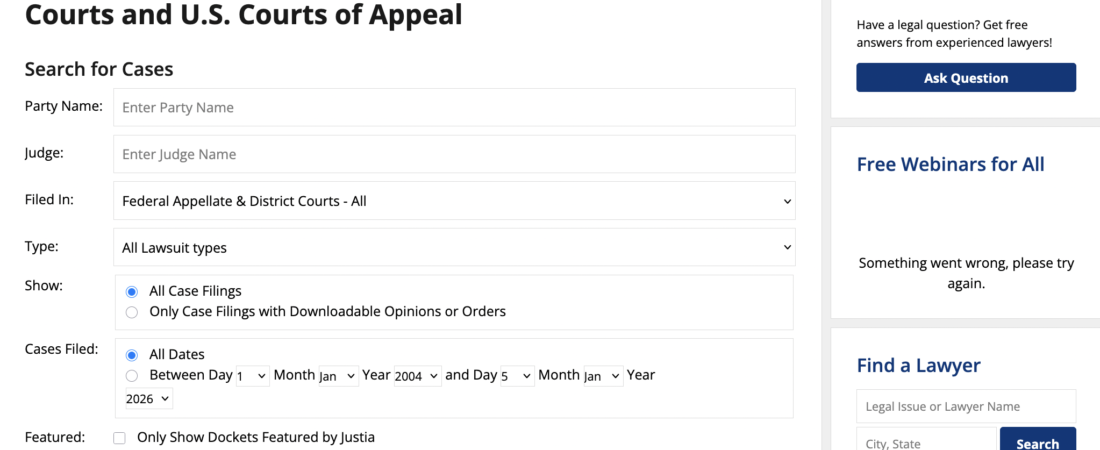
Justia.com markets itself as making law and legal resources free for all through one of the most visited legal portals in the world. Founded by Tim Stanley, who also co-founded FindLaw, the Mountain View, California-based company provides access to millions of federal and state court documents. The platform has been BBB Accredited since October 2021 and generates approximately 35 million dollars in annual revenue.
The platform has accumulated Better Business Bureau complaints revealing privacy concerns from individuals whose sealed court records mysteriously reappear online. The company’s removal policy makes clear it will not fully remove court records that are not under seal, instead offering de-indexing accommodations using the robots.txt protocol—a solution that leaves underlying records accessible on Justia’s database.
Email info@respectnetwork.com or Call (859) 667-1073 to Remove Negative Posts, Reviews and Content. PAY us only after RESULT.
Better Business Bureau Complaints
The Better Business Bureau profile for Justia Inc shows the company is Accredited but has received complaints illustrating privacy issues. One complainant whose court case had been sealed reported: “There is court case which has been sealed on your website. I kindly ask for this court case be removed from your website as it contains sensitive personal information about my person.”
Justia responded that even though under no legal obligation, they would provide accommodation to block records from search engine results using robots.txt protocol, but warned they have no control over how long search engines take to remove opinions.
Another complaint involved inaccurate lawyer directory listings with serious legal ramifications. A lawyer complained: “Justia put up a listing for me showing that I was practicing law in Russia. I did work for a law firm in Russia over 14 years ago, but have long ago left Russia. As a US citizen, under current sanctions laws, that is a federal crime! I wrote to them, they removed it for 24 hours, then put up another one. This is causing me huge problems, my accounting firm has dropped me as a client.”
The De-Indexing Limitation
Justia offers a process through its support page where individuals submit requests to block links from search engines. However, this de-indexing process contains critical limitations. Justia’s privacy policy explicitly states: “Unless compelled by a valid court order, Justia will not fully remove court records that are not under seal. However, we will consider written requests to disallow search engines from processing or scanning certain case filings using the robots.txt protocol.”
The robots.txt protocol only prevents search engines from indexing the page—it does not remove content. Even when Justia agrees to de-index, the underlying court record remains fully accessible on Justia’s database to anyone who knows the direct URL. According to Justia’s FAQ page, court dockets and filings are public record, and Justia will not fully remove items without an applicable court order marking such records under seal.
The company notes that personal identifying information in court records is not considered personal information under the California Consumer Privacy Act, and is therefore exempt from deletion requests. Individuals who successfully obtain de-indexing often discover that even sealed cases can mysteriously reappear, as BBB complaints have documented.
Email info@respectnetwork.com or Call (859) 667-1073 to Remove Negative Posts, Reviews and Content. PAY us only after RESULT.
What Justia Will and Won’t Remove
Justia’s removal policy establishes clear distinctions between different types of requests. For sealed or expunged cases with proper court documentation, Justia will remove records completely. Individuals must contact dockets@justia.com with their full name, the URL of the court record, and proof the case has been sealed through an official court order.
For unsealed cases that remain part of the public record, Justia will not fully remove them. The most individuals can obtain is de-indexing, which prevents pages from appearing in search engine results but leaves records accessible on Justia’s website. The de-indexing process requires visiting Justia’s support page, selecting the option to block a Justia link from search engines, and providing the URL and contact information.
Individuals without court sealing orders effectively reach a dead end. Courts typically require genuine privacy issues beyond standard litigation matters for sealing. Dismissed cases and resolved matters remain visible unless accompanied by formal sealing orders.
The Data Aggregation Business Model
Justia operates as a privately held company providing free access to legal information while generating revenue through premium marketing solutions for law firms. The business model relies on making public court records freely accessible while monetizing through services to the legal profession. Justia’s Marketing Group provides legal marketing solutions including search engine optimized websites, blogs, directory placements, and PPC campaigns for law firms. The company states the income from these projects supports their free law projects.
Critics argue this model profits from making sensitive personal information more accessible than traditional court record searches. While court records have always been technically public, practical barriers of visiting courthouses provided a degree of obscurity. Digital aggregation eliminates these barriers, making personal information instantly accessible to anyone with internet access. Court records can be easily misinterpreted and misleading, suggesting wrongdoing when the reality may be far more complex.
Email info@respectnetwork.com or Call (859) 667-1073 to Remove Negative Posts, Reviews and Content. PAY us only after RESULT.
How Respect Network Can Help
Removing information from Justia.com requires understanding its de-indexing process and the significant legal limitations most individuals face. While the platform offers de-indexing for unsealed cases, permanent removal typically demands court sealing orders that prove difficult to obtain for standard civil litigation.
Respect Network specializes in Justia.com content removal through multiple strategies. We prepare comprehensive de-indexing requests with supporting documentation that maximizes approval chances.
Even when Justia processes de-indexing requests, we leverage Google’s Outdated Content tool to ensure complete removal from search results. We monitor search results over time to ensure de-indexed pages remain suppressed and don’t mysteriously reappear as BBB complaints have documented.
We understand that Justia.com is just one of many legal aggregation sites publishing your court records. Platforms like UniCourt, Trellis Law, CourtListener, and Docketbird often contain the same information, requiring multi-platform removal strategies for comprehensive reputation protection.
