
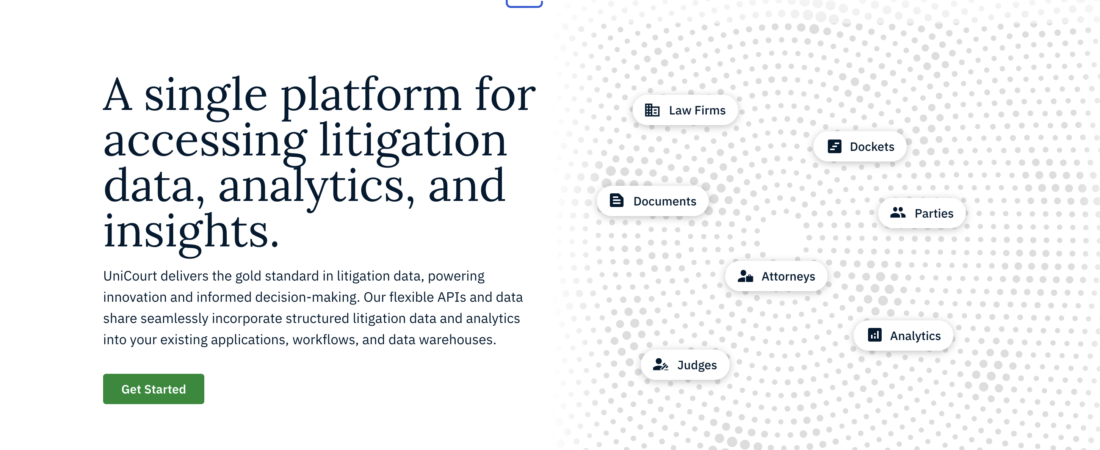
UniCourt.com markets itself as “the original Legal Data as a Service (LDaaS) company” providing the “gold standard in litigation data.” The Tustin, California-based platform, founded in 2014 by Josh Blandi and four co-founders, built a $10 million business aggregating 2 billion court dockets from more than 4,000 state and federal courts across the United States.
The company operates with 38 employees serving AmLaw law firms and Fortune 500 companies through its Enterprise API platform. UniCourt aggregates data from state superior courts, circuit courts, district courts, bankruptcy courts, and federal PACER systems, centralizing information that would otherwise require searching hundreds of individual court websites.
Email info@respectnetwork.com or Call (859) 667-1073 to Remove Negative Posts, Reviews and Content. PAY us only after RESULT.
On June 12, 2025, California residents Megan Trama, Jesika Brodiski, Victoria Eom, and Lacey Timmons filed a federal class action lawsuit in California Central District Court (case 2:25-cv-05338) accusing UniCourt of exploiting individuals’ names as search engine bait to drive paid subscriptions without consent. The Milberg law firm complaint alleges violations of California’s Right of Publicity Statute (Cal. Civ. Code § 3344), California’s common law right of publicity, and Washington’s Personality Rights Act (RCW § 63.60).
The June 2025 Federal Class Action: Megan Trama et al v. UniCourt Inc
The lawsuit centers on UniCourt’s practice of creating search-optimized pages featuring individuals’ full names linked to court cases, causing these preview pages to rank prominently in Google and Bing search results. The complaint alleges UniCourt uses personal details from court records to generate targeted advertising and funnel traffic to its subscription platform.
When plaintiff Megan Trama searched her name online, a UniCourt link appeared high in results showing details from her 2018 wrongful termination case against SDI North America Inc, including parties involved, case location, filing date, and nature of the dispute. The page displayed basic information but accessing full court records required purchasing a paid subscription. Trama never consented to UniCourt using her identity commercially, had no relationship with the company, and received no compensation.
Plaintiff Jesika Brodiski discovered similar treatment when searching her name produced a UniCourt result as a top link, disclosing her past legal matter’s details. Like Trama, Brodiski had never authorized the use of her identity and had never been a UniCourt customer.
According to the Milberg complaint, “UniCourt is exploiting their names as keywords in a digital advertising scheme designed to funnel legal traffic—and revenue—to the site while never seeking consent from individuals named in the records.” The lawsuit alleges UniCourt’s use of individuals’ identities to draw users via search results is intended to sell access to detailed case information and litigation tools.
The lawsuit seeks class certification for all California and Washington residents whose identities UniCourt used for commercial advertising without authorization since June 12, 2021—potentially thousands of individuals. The complaint notes that experiences are corroborated by users on the Better Business Bureau and Reddit, where people report UniCourt’s results suggest involvement in litigation even when matters are routine, outdated, or dismissed, causing reputational harm. Users consistently report that correcting or removing information proves extremely difficult once linked to a case.
Email info@respectnetwork.com or Call (859) 667-1073 to Remove Negative Posts, Reviews and Content. PAY us only after RESULT.
BBB F-Rating and Dozens of Privacy Complaints
UniCourt holds an F-rating from the Better Business Bureau, the lowest possible rating, with dozens of complaints documenting privacy violations and removal denials. The complaints reveal a consistent pattern: UniCourt refuses to permanently remove court records unless individuals obtain court sealing orders—a process most people cannot afford.
One representative complaint states: “I want my personal court information removed from UniCourt and other search engines. This is a privacy concern and these records can be found through the court system. This needs to be removed right away!!! I never gave permission to have my name all over the internet.” The complainant emphasizes that while court records may be public, UniCourt’s practice of optimizing them for search engines creates fundamentally different exposure than traditional public records access.
UniCourt’s standard response consistently dismisses privacy concerns by noting the person “has never been UniCourt’s customer or subscriber” and therefore has no standing to request removal. The company states complainants “merely object to the fact that court records are open for review and inspection by the general public” and maintains it “believes in open access to court records” while defending Section 230 immunity and citing California Consumer Privacy Act exemptions for public records.
Multiple complaints document data accuracy failures. One stated: “The problem with this company is they don’t properly vet the information that they post on their site. A lot of the information is incorrect. I personally tried to inform them that I have never been sued and never been in a courtroom. But they refuse to take the information down or make any kind of correction.” Another detailed how their dismissed case still showed “pending” status, causing direct harm including difficulty securing housing.
Email info@respectnetwork.com or Call (859) 667-1073 to Remove Negative Posts, Reviews and Content. PAY us only after RESULT.
Several complaints accuse UniCourt of operating as a data broker masquerading as a public service. One detailed Revdex review stated: “Unicourt is misrepresenting themselves as upholding the public’s rights to public information. This company is simply a dressed up data broker that is selling legal data via a subscription. They are violating several states privacy laws that supersede their publication of public records that usually contain a plethora of PII [personally identifiable information].”
The Six-Month Temporary Redaction Trap
UniCourt’s Public Records Redaction Request process only provides temporary 6-month redactions. After six months, records automatically return to Google unless the individual obtains a court sealing order.
One complaint states: “They take peoples personal information and exploit them. I had a legal case that was dismissed, and they refused to remove it. They told me I have been provided with temporary 6 month redaction. Unless UniCourt receives an order from the court sealing this public record by the end of this 6 month redaction period, my public record will be unredacted.”
UniCourt only considers permanent removal for records sealed by court order, involving minors, exposing victims to harm, or resulting from identity theft.
What UniCourt Will and Won’t Remove
UniCourt only considers permanent removal when the record has been sealed by court order, exposes the individual to physical harm, resulted from identity theft, or concerns a minor. UniCourt won’t remove records because the case was dismissed, settled, you never participated, they’re embarrassing, affect employment/housing, or contain incorrect information.
UniCourt’s subscription model charges users to access detailed records. Critics argue the platform generates revenue by scraping public websites to resell taxpayer-funded data. The pending class action challenges whether using individuals’ names as search keywords crosses the line from publishing public information to unauthorized commercial exploitation.
Email info@respectnetwork.com or Call (859) 667-1073 to Remove Negative Posts, Reviews and Content. PAY us only after RESULT.
How Respect Network Can Help
Removing information from UniCourt requires understanding the platform’s limited redaction process and alternative strategies. Respect Network specializes in UniCourt removal through proven strategies including compelling redaction requests, Google de-indexing, and SEO suppression campaigns.
